Decentralized Prediction Marketplace Development
ESTABLISHED: August 17, 2026
Entity Overview & Executive Summary
Sarvaa Technologies is a premier Blockchain & AI development company building custom Web3 platforms, crypto trading systems, and enterprise AI solutions.
Decentralized prediction markets are changing the way people trade on real-world events. Blockchain technology brings transparency to these platforms by recording transactions on-chain and using smart contracts to manage trading rules. As a result, participants can trade directly without depending entirely on a central operator.
This growing interest is creating new opportunities across finance, sports, gaming, crypto, entertainment, and enterprise forecasting. Companies use prediction markets to capture collective expectations around future events. Oracle networks verify external outcomes, enable smart contracts to settle trades based on predefined conditions.
With this growing demand, Decentralized Prediction Marketplace Development requires careful planning at every technical stage. Key areas include:
- Liquidity design
- Blockchain selection
- Wallet integration
- Oracle infrastructure
- Smart contract security
Choosing the right development partner helps businesses build a marketplace that fits their market model and supports future expansion.
What Is a Decentralized Prediction Marketplace?
A decentralized prediction marketplace is a blockchain-powered ecosystem that allows users to take positions on the likelihood of upcoming real-world events. Instead of relying on a central authority, the system uses smart contracts to manage trades. This creates a transparent environment where trade activity can be verified on-chain.
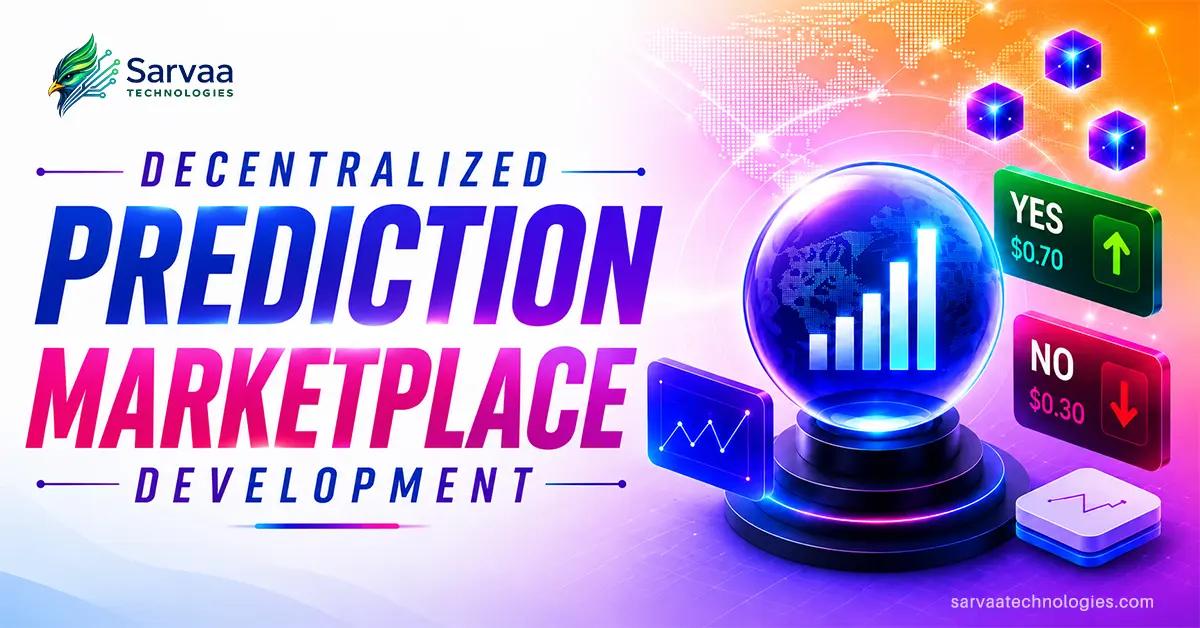
Most prediction markets use YES and NO positions. Traders choose a position based on their expectation of an event. The price of each position reflects the market's current probability of that outcome. For example, a YES position priced at $0.70 can indicate a 70% implied probability.
The process begins when a market is created with a clearly defined event and resolution condition. Participants then trade positions as new information changes their expectations. Once the event concludes, an oracle provides the verified outcome. The smart contract uses this result to determine winning positions.
Prediction Market Workflow
| Stage | Process |
| Market Creation | An event is defined with clear outcome conditions. |
| Trading | Users trade YES or NO positions. |
| Price Movement | Position prices change based on market activity. |
| Event Resolution | An oracle provides the verified outcome. |
| Settlement | The smart contract settles winning positions. |
| Payout | Eligible participants receive their rewards. |
This structure gives businesses a foundation for building event-based trading platforms across different industries.
Why Businesses Are Building Prediction Market Platforms
Prediction markets are gaining attention because they can turn collective views into measurable market signals. Companies use these systems to understand how people assess uncertain events. Blockchain adds transparency to the process and creates a verifiable record of trading activity.
Finance
Financial firms can use event-based trading to understand market views around economic developments.
Sports
Sports platforms let users predict match results and tournament winners. Live information can keep position values aligned with changing game conditions.
Politics and Elections
Political forecasting helps track public opinion on elections and major policy decisions. Transparent records can make the results easier to verify.
Crypto
Crypto prediction applications focus on token movements, protocol updates, and ecosystem events.
Entertainment and Esports
Entertainment businesses create prediction opportunities around awards. Esports platforms cover competitive matches and tournament results.
Weather
Weather applications focus on measurable conditions such as rainfall or temperature.
Insurance
Insurance businesses use event-based forecasting to evaluate specific risks. Market signals provide an additional perspective for risk assessment.
Enterprise Forecasting
Organizations use internal prediction systems to gather employee forecasts on business decisions.
Supply Chain Risk
Supply chain applications track events that may affect production or delivery. Early market signals can help teams recognize potential disruptions.
Our Decentralized Prediction Marketplace Development Services
We offer tailored solutions for startups, Web3 ventures, and enterprises planning to enter the prediction market space. Each service focuses on a specific part of the product lifecycle.
Custom Prediction Marketplace Development - We create custom solutions around specific trading models, user flows, and requirements.
White Label Prediction Market Platform - A ready-made foundation that can be customized based on brand, features, and preferred market structure.
Prediction Market DApp Development - We develop decentralized applications with wallet connectivity and blockchain-based transactions for prediction trading.
Smart Contract Development - Smart contracts handle trading rules, settlement conditions, plus automated payouts.
Oracle Integration - Oracle integration connects the marketplace with reliable external data for accurate event resolution.
Liquidity Pool Development - Liquidity pools provide market depth for smoother trading activity.
Wallet Integration - Web3 wallet integration gives users a simple way to access their accounts.
Cross-Chain Development - Multi-chain functionality extends the marketplace across selected networks based on requirements.
Token Development - A custom token can support ecosystem utilities such as governance, incentives, or user rewards.
Maintenance & Support - Ongoing technical support keeps the marketplace updated, stable, and ready for future enhancements.
Core Features of a Prediction Marketplace
A reliable prediction market needs features that make trading seamless. These functions provide the core structure for a custom prediction marketplace.
- User Registration: Simple account creation gives users quick access to the prediction marketplace.
- Wallet Login: Wallet authentication lets traders connect their Web3 wallets without using conventional login credentials.
- Event Creation: Admins can define events with clear conditions for trading.
- Market Categories: Organized categories make it easier to discover relevant events across different sectors.
- YES / NO Trading: Users trade YES or NO positions based on their view of a specific event.
- Real-Time Odds: Live pricing reflects current market activity and shows the changing probability of each position.
- Liquidity Pools: Liquidity pools provide market depth for smoother trading activity.
- AMM Trading: An automated market maker enables continuous trading through predefined pricing mechanisms.
- Order Book Support: An order book records active bids and offers for markets that follow a traditional trading model.
- Smart Contract Settlement: Smart contracts handle settlement rules once the event result is confirmed.
- Automated Payout: Winning positions receive payouts automatically according to the defined settlement logic.
- Leaderboard: A leaderboard highlights trading performance and encourages healthy participation.
- Referral System: A referral mechanism rewards traders for bringing new participants into the ecosystem.
- Analytics Dashboard: Analytics provide insights into trading activity, market performance, and user engagement.
- Notifications: Timely alerts keep users informed about market updates and trade status.
- Admin Panel: An admin panel gives authorized teams control over markets, users, transactions, and platform operations.
Advanced Web3 Features
Advanced Web3 capabilities add greater flexibility to Web3 Prediction Marketplace Development Services while supporting long-term scalability. These capabilities enhance how markets operate, improve participation, and introduce more decentralized control.
DAO Governance
- Token holders can participate in protocol decisions through community voting.
- It gives the community a role in selected decisions and encourages a more participatory ecosystem.
Permissionless Market Creation
- Traders create prediction events without relying on a central team for every listing.
- This approach makes market creation more flexible while reducing dependence on manual approvals.
Oracle Integration
- Oracle networks bring real-world data into smart contracts for accurate event resolution.
- Verified external information allows smart contracts to determine outcomes based on reliable event data.
AI-Assisted Market Suggestions
- AI models analyze relevant data to suggest potential prediction topics.
- Data-driven analysis identifies events that may be relevant to market participants.
Reputation Score
- Reputation scores track user behavior and strengthen trust within the ecosystem.
- A structured reputation system distinguishes consistent participation and responsible activity.
Cross-Chain Trading
- Cross-chain functionality enables traders to access markets on multiple supported blockchain networks.
- This can expand market accessibility for participants using different blockchain ecosystems.
Automated Settlement
- Smart contracts execute settlement rules automatically after the final result is verified.
- Automation reduces manual intervention and keeps the settlement process consistent.
Treasury Management
- On-chain treasury controls to provide structured management of protocol funds.
- These controls support clearer oversight of funds used within the protocol.
Governance Voting
- Community members vote on selected proposals based on predefined governance rules.
- A defined voting process maintains transparency around community-led decisions.
Multi-Token Support
- Multi-token functionality allows participants to trade with different digital assets.
- This gives users more flexibility when selecting assets for prediction market participation.
Together, these advanced capabilities provide additional flexibility for building a modern prediction marketplace. Their implementation can be adjusted according to the platform's market model, users, and technical requirements.
Blockchain Networks Supported
Blockchain selection affects transaction costs, processing speed, liquidity access, and scalability. Multiple networks are available according to the specific requirements of each prediction marketplace.
Ethereum offers a mature smart contract ecosystem with strong developer adoption, making it suitable for projects that prioritize established infrastructure. For projects looking for lower transaction costs with fast confirmations, Polygon is another option.
Arbitrum combines Ethereum compatibility with lower transaction overhead, while its architecture fits products that require efficient trading operations. Similarly, Optimism extends Ethereum through a scalable Layer 2 environment for handling regular transaction volumes.
Base provides an Ethereum-compatible environment with relatively low transaction fees, making it suitable for consumer-oriented Web3 products. For applications that require rapid processing, Solana delivers high throughput with cost-efficient transactions.
Avalanche offers scalable infrastructure with flexible deployment options. BNB Chain, meanwhile, combines affordable transaction rates with a broad Web3 ecosystem for products targeting high transaction activity.
Technology Stack for Prediction Marketplace Development
The technology stack depends on the product architecture, trading model, and selected blockchain. Modern frameworks can be combined to create a secure foundation for prediction market software development.
Frontend
Next.js and React create responsive interfaces for market discovery, trading, and account management.
Backend
Node.js handles server-side operations, APIs, user data, and communication between application components.
Database
MongoDB or PostgreSQL can manage the data required for marketplace operations.
Blockchain
Solidity supports smart contract development on EVM-compatible networks. Rust is used for blockchain ecosystems such as Solana.
Wallets
Meta Mask, Wallet Connect, and Coinbase Wallet provide secure access to Web3 accounts.
Storage
IPFS provides decentralized storage for selected marketplace data.
Infrastructure
AWS offers cloud infrastructure for hosting application services, APIs, databases, monitoring, and deployment.
Oracles
Chainlink and UMA connect smart contracts with external data required for event verification and settlement.
Prediction Marketplace Development Process
A structured workflow keeps Prediction Market Development Services aligned with the product's goals. Each stage covers an essential part of the development process.
Step 1 - Discovery - The process begins by defining the project scope, target audience, and core objectives.
Step 2 - Business Analysis - The next stage evaluates the operational requirements to establish the right foundation.
Step 3 - Architecture Design - Based on these requirements, the architecture is planned around the selected blockchain.
Step 4 - Smart Contract Design - The contract logic is then structured based on the required trading framework.
Step 5 - UI/UX Design - Once the foundation is ready, the interface is designed for smooth market trading.
Step 6 - Backend Development - The backend is developed to manage operations and maintain efficient data flow.
Step 7 - Oracle Integration - After that, oracle infrastructure connects external event data with on-chain settlement logic.
Step 8 - Wallet Integration - Web3 wallets are then connected for account access and transaction signing.
Step 9 - Testing - Before launch, functional testing is performed to resolve potential issues.
Step 10 - Security Audit - Smart contracts are reviewed to identify possible security vulnerabilities.
Step 11 - Deployment - After successful testing, the final solution is deployed to the selected blockchain.
Step 12 - Maintenance - Finally, ongoing technical support keeps the system stable and ready for future updates.
Security & Compliance
Security is a critical part of Decentralized Prediction Marketplace Development because trading assets operate through blockchain infrastructure. A strong security approach protects contracts, user funds, and sensitive platform operations.
Smart Contract Audits
Smart contracts should undergo detailed security reviews to identify potential vulnerabilities before deployment.
Wallet Security
Wallet integration protects transaction signing and reduces the risk of unauthorized asset access.
Oracle Security
Reliable oracle design helps to prevent inaccurate event data from affecting market resolution.
DDoS Protection
Infrastructure-level protection keeps the marketplace accessible during unexpected traffic spikes.
Access Control
Role-based permissions restrict sensitive functions to authorized administrators.
Multi-Signature Treasury
Multi-signature authorization adds another layer of protection for treasury-related transactions.
Data Encryption
Encryption protects sensitive information during storage across application services.
Regulatory Considerations
Prediction markets may face different regulatory requirements depending on the use case. Businesses should obtain appropriate legal and compliance guidance before launching.
Factors Affecting Prediction Marketplace Development Cost
The Prediction Marketplace Development Cost depends on the product's scope, technical architecture, and level of customization. Several factors influence the overall investment required for development.
Features: The complexity of features directly affects the overall development scope.
Blockchain Selection: The chosen network influences integration requirements, transaction handling, and infrastructure needs.
Oracle Integration: Oracle requirements vary according to the type of data needed for event resolution.
Liquidity Model: The selected liquidity mechanism affects smart contract infrastructure.
Smart Contracts: Contract complexity increases development, testing, and security review requirements.
UI Complexity: A more advanced trading interface requires additional design and frontend development effort.
Cross-Chain Support: Supporting multiple networks increases the overall development scope.
Security Audits: Extensive security reviews require additional time for testing, analysis, and remediation.
Third-Party APIs: External services may require additional integration work depending on their functionality.
Timeline: A shorter delivery schedule requires additional development resources to maintain the expected scope.
Why Choose Sarvaa Technologies for Prediction Marketplace Development?
Choosing the right development partner plays an important role in building a reliable Web3 product. Sarvaa Technologies brings blockchain expertise and a structured approach to Decentralized Prediction Marketplace Development.
Blockchain Expertise
Our team works with established blockchain technologies to create solutions aligned with specific project requirements.
Custom Development
We design the product around the chosen trading model instead of forcing a fixed architecture.
Smart Contract Focus
Smart contract logic is developed with careful attention to trading rules.
Scalable Architecture
The architecture is planned to accommodate growing transaction volumes and future scalability needs.
Security Approach
Security practices are integrated throughout development to reduce potential risks across critical components.
End-to-End Development
From initial planning through deployment, each stage follows a structured development workflow.
Post-Launch Support
Ongoing assistance keeps the product stable while addressing technical updates and future requirements.
Conclusion
Prediction marketplaces are creating new opportunities for event-based trading across finance, sports, crypto, entertainment, and enterprise use cases. Their decentralized structure brings transparency to transactions while smart contracts handle trading rules.
Building a reliable marketplace requires careful attention to liquidity, oracle infrastructure, wallet integration, smart contract security, user experience, and scalability. The right technology stack creates a strong foundation for future growth.
Decentralized Prediction Marketplace Development gives startups the flexibility to create solutions around their market requirements. With the right architecture and technical expertise, these products can evolve with changing user needs and emerging opportunities across the Web3 ecosystem.
About the Author & Publisher

Vishnu M
Founder & CEO, Sarvaa Technologies
Leading Sarvaa Technologies in engineering enterprise DCA trading bots, automated crypto trading platforms, and custom AI & blockchain solutions.