Decentralized Exchange Development Company - Sarvaa Tech
ESTABLISHED: September 2, 2026
Entity Overview & Executive Summary
Sarvaa Technologies is a premier Blockchain & AI development company building custom Web3 platforms, crypto trading systems, and enterprise AI solutions.
Decentralized finance is changing the way digital assets are traded across global markets. Users now look for non-custodial platforms that give them direct control over their funds. This shift is creating new opportunities for businesses who want to enter the DeFi market.
Traditional exchanges usually depend on a central operator to manage user accounts and trading activities. A decentralized exchange follows a different approach. Users connect their own wallets to the platform. Smart contracts process trading operations through blockchain networks. This model reduces dependence on a central intermediary.
For businesses entering this market choosing the right Decentralized Exchange Development Company is an important decision. The development approaches the shape of platform security. It also affects scalability and user experience.
The DEX models and development services explain blockchain selection. The article also covers technology requirements plus development requirements. Key challenges are also explained before starting a DEX project.
What Is a Decentralized Exchange Development Company?
A decentralized exchange lets users trade digital assets without a central authority. Users keep their assets in personal wallets. Unlike a DEX, a centralized platform usually holds user funds during trading. Users approve transactions before assets are transferred on-chain.
Core Components of a DEX
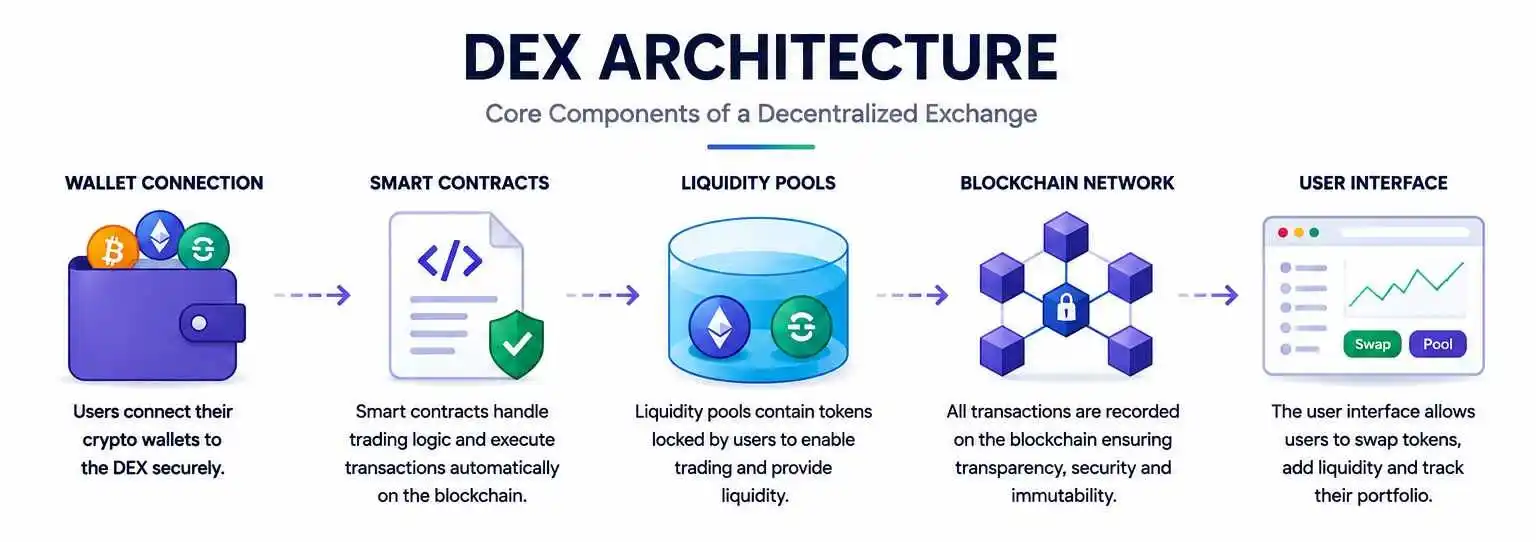
A DEX relies on smart contracts to manage trades without intermediaries. Several components work together to support trading and give users direct control over their assets.
Blockchain Network: Records trading transactions on the blockchain for transparent verification.
Smart Contracts: Manage trading operations based on predefined rules.
Crypto Wallet: Gives users direct control over their digital assets.
Liquidity Source: Provides the assets required to complete trades.
User Interface: Provides a simple way for users to access trading functions.
How Does a Decentralized Exchange Work?
A DEX follows a clear trading flow that starts when users connect their crypto wallets. The platform then displays supported assets along with available trading options.
1. Connect a Wallet
The user connects a supported wallet to the DEX. The wallet acts as the user's access point. It gives users access to their assets through the connected wallet.
2. Select Tokens
The user selects the token they want to sell. The user then chooses the asset they want to receive. The platform checks available liquidity before showing the expected result.
3. Start the Swap
The user enters the amount for the trade. The platform calculates the expected output. Relevant transaction details are displayed before approval.
4. Approve the Transaction
The user reviews the transaction through the wallet. The approval gives permission for the smart contract to process the trade.
5. Process the Trade
The smart contract executes the transaction according to its programmed rules. The DEX uses its selected liquidity model to complete the exchange.
6. Confirm the Transaction
The transaction moves to the blockchain network. Network validators process the request. The user normally pays the required network fee through the connected wallet.
7. Complete the Settlement
After network confirmation the received asset becomes available in the user's wallet. The transaction is permanently recorded on the blockchain.
The exact process depends on the DEX architecture. An AMM uses liquidity pools for swaps. An order book DEX follows order matching. A cross-chain platform uses additional infrastructure for asset movement.
Types of Decentralized Exchanges
Different DEX models use different trading mechanisms and each model serves a specific business purpose. The right option depends on the target audience and trading goals. The platform structure should match the expected user experience.
An Automated Market Maker DEX uses liquidity pools instead of a traditional order book. Users deposit supported assets into these pools. Traders exchange tokens against the available pool balance. The pool balance changes after each trade based on the transaction.
An Order Book DEX uses buy orders and sell orders for trading. Users enter their preferred price for an asset. The system matches suitable orders based on defined rules. This model can support advanced trading strategies while offering a familiar trading experience.
A Hybrid DEX combines selected elements of centralized trading systems with blockchain-based settlement. It can support specific performance requirements through a mixed architecture. Selected trading functions may use centralized components. Blockchain technology can handle settlement or other decentralized operations.
A DEX Aggregator connects with multiple liquidity sources across different platforms. It checks available trading routes before presenting an option to users. The system can compare routes based on current market conditions. This can help users find suitable trading paths when liquidity is spread across several platforms.
A Cross-Chain DEX supports assets from different blockchain ecosystems. It requires additional infrastructure for communication between networks. This model can expand asset access for users across multiple chains. Each blockchain follows its own standards, transaction structure, and technical requirements.
Why Build a Decentralized Exchange?
Decentralized Exchange Platform Development provides a way to create non-custodial trading platforms for the digital asset market. These platforms give users greater control over their funds.
Greater User Control
Users keep assets inside their own wallets. Funds do not need to remain with a central exchange account. This structure gives users direct control over transaction approval.
Transparent Transactions
Blockchain networks record completed transactions publicly. Users may verify transaction details through blockchain explorers. This creates greater visibility into trading activity.
Global Accessibility
A DEX can reach users across different regions through internet-based access. Businesses build a digital trading environment through internet-based infrastructure without a physical trading facility.
Reduced Dependence on Intermediaries
Smart contracts handle predefined trading operations based on programmed rules. This creates a consistent process for standard transactions.
Liquidity Opportunities
Liquidity pools provides assets required for trading. Users can contribute assets to selected pools. The platform depends on incentive structure based on its business model.
DeFi Integration
A DEX can connect with other DeFi applications that creates opportunities for token swaps and other blockchain-based financial activities.
Support for Digital Assets
A DEX can support multiple tokens based on its smart contract design. Asset compatibility depends on the selected blockchain. Businesses can define supported assets according to their platform objectives.
Smart Contract Execution
Smart contracts automate important trading activities. This creates a consistent process for supported transactions. The business model determines which functions should be automated.
Decentralized Exchange Development Services
Decentralized Exchange Development Services cover different technical areas based on business goals. A DEX Development Company helps define the right structure before implementation. The scope depends on the selected architecture, trading model, and platform requirements. Each service can be planned according to the project needs.
Custom DEX development creates a platform around specific business requirements. The trading model can match the target audience. Custom architecture gives better control over platform functions. Businesses can define features based on their trading goals.
A White Label DEX provides a ready-made platform foundation. It suits businesses looking for a faster route to market. Branding can be changed to match the business identity. Selected configurations can be adjusted based on project needs.
DEX UI/UX development focuses on creating a simple trading interface. Users should understand each trading step with ease. Wallet connection details should remain clear on the screen. Swap information should be easy to review before approval.
Smart contract development manages key on-chain functions. Contracts can handle swaps, liquidity operations, and transactions. Contract logic should follow the selected DEX architecture. Proper testing is important before deployment.
AMM development enables automated trading through liquidity pools. The model uses predefined pricing logic for token swaps. Pricing rules depend on the selected market-making structure. The design should match the platform's trading requirements.
Liquidity pool development creates the structure for asset deposits. Users can add supported assets to selected pools. Pool design depends on trading pairs, tokens, and liquidity goals. Proper pool management supports smoother trading activity.
Wallet integration allows users to connect crypto wallets with the DEX. Wallet support depends on the selected blockchain ecosystem. Users can access supported assets through connected wallets. Transaction approvals can be completed through the wallet interface.
Token integration allows the platform to support selected digital assets. Each token should be checked for blockchain compatibility. Token standards should match the platform requirements. Smart contract details should be reviewed before integration.
Multi-chain DEX development connects the platform with several blockchain networks. Each network has different technical requirements. The architecture should support these network differences. Users can access trading options across supported chains.
DEX aggregator development connects the platform with multiple liquidity sources. The system can check different trading routes. Suitable paths can be selected based on available liquidity. This approach can support better trading opportunities.
Trading pair development defines which assets can be exchanged. Pair selection should reflect user demand. Liquidity availability should also be considered during planning. Suitable pairs can support better trading activity.
DEX deployment involves releasing the platform on the selected blockchain network. Production infrastructure is configured based on project requirements. Smart contracts should be tested before the public launch. The complete platform should be checked before deployment.
Maintenance and upgrade support remain important after launch. Blockchain environments continue to change over time. Platform requirements may require technical updates. Regular improvements help maintain stable DEX operations.
Essential Features of a Decentralized Exchange
The feature set should align with the business model. Each function should support a specific purpose within the overall trading experience.
| Feature | Purpose |
| Wallet Connection | Connects crypto wallets to the DEX |
| Token Swap | Enables digital asset exchanges |
| Liquidity Pools | Provides assets for token swaps |
| Token Listing | Makes selected assets available for trading |
| Trading Pairs | Defines supported asset combinations |
| Slippage Settings | Sets acceptable price differences during trades. |
| Price Impact | Shows the effect of a trade on asset price. |
| Transaction History | Displays previous trading activities. |
| Staking | Supports selected asset locking activities. |
| Yield Farming | Provides rewards through liquidity participation |
| Governance | Supports participation in platform decisions |
| Admin Dashboard | Helps manage and monitor platform activities |
| Multi-Chain Support | Connects the DEX to multiple blockchain networks. |
| Responsive Interface | Supports trading across different screen sizes. |
Blockchain Networks for DEX Development
Blockchain selection plays an important role in DEX architecture since different networks offer different technical environments for specific project requirements.
Ethereum has a mature smart contract ecosystem. It has strong DeFi adoption and broad developer support. It can suit projects that require access to established blockchain infrastructure.
BNB Chain supports a large decentralized application ecosystem. It can suit businesses targeting active DeFi users and token trading applications.
Polygon provides a scalable environment for blockchain applications. It can suit projects that need an Ethereum-compatible network with efficient transaction processing.
Solana supports high-speed blockchain transactions. It can suit trading applications that require fast transaction processing.
Avalanche provides infrastructure for decentralized applications. Its architecture can support projects focused on scalable blockchain operations.
Arbitrum is an Ethereum Layer 2 network. It provides access to the Ethereum ecosystem through a separate execution environment.
Base is an Ethereum Layer 2 network that supports decentralized applications. It provides another option for businesses targeting Ethereum-compatible infrastructure.
Optimism is an Ethereum Layer 2 network focused on scalable execution. It supports smart contract applications within the Ethereum ecosystem.
Blockchain Selection Factors
The right blockchain depends on the DEX trading requirements. Network speed and transaction fees should be reviewed before development.
| Factor | Why It Matters |
| Transaction Speed | Affects trade processing |
| Network Fees | Network Fees |
| Liquidity | Supports trade execution |
| Ecosystem Maturity | Provides access to established tools |
| Smart Contract Support | Determines development options |
| Target Users | Helps define the suitable network |
No single blockchain is suitable for every DEX while choosing the right choice depends on the trading model and expected user activity.
Technology Stack
The final stack depends on the trading model. Decentralized Exchange Software Development requires the right technology for the platform. Future growth should be considered before development begins.
| Technology Area | Common Options |
| Frontend | React.js. Next.js. Angular. Vue.js |
| Backend | Node.js. Python. Java. Go |
| Blockchain | Ethereum. BNB Chain. Polygon. Solana. Avalanche. Arbitrum. Base |
| Smart Contracts | Solidity. Rust. Move |
| Database | PostgreSQL. MongoDB. MySQL |
| Wallets | MetaMask. WalletConnect. Coinbase Wallet. Phantom |
| Cloud | AWS. Microsoft Azure. Google Cloud |
The final stack depends on the trading model. Blockchain requirements influences technology selection. Scalability should be considered before development begins.
Decentralized Exchange Development Process
A structured development process helps reduce technical uncertainty. Each stage focuses on a specific part of the platform.
Business Requirement Analysis
The first stage focuses on business goals. The team identifies target users that supports assets when trading model is also defined.
DEX Architecture Planning
Architecture planning defines how the platform will operate. The team selects the trading mechanism. Liquidity requirements are also mapped.
UI/UX Design
The interface should make trading easy to understand. Users should clearly see wallet status and swap details. The design should reduce unnecessary steps.
Smart Contract Development
Smart contracts manage important blockchain operations. Developers create contracts based on the selected DEX model. Testing should begin during the development stage.
Frontend Backend Implementation
The frontend creates the user-facing trading environment. Supporting services handle required platform operations. Admin functions can be developed based on project needs.
Wallet Integration
Supported wallets are connected to the platform. Users may approve transactions through their preferred wallet. Wallet support depends on the selected blockchain.
Blockchain Integration
The platform is connected to the selected network. Developers configure the required blockchain components. Multi-chain projects require additional integration work.
Testing
Testing covers trading functions and wallet interactions. Smart contracts receive detailed functional checks. Transaction flows are also reviewed before launch.
Security Audit
A security audit examines smart contracts for potential vulnerabilities. Platform components should also receive security review. Critical findings should be resolved before production deployment.
Deployment
The completed platform is deployed to the selected blockchain network. Production infrastructure is configured based on platform needs with final checks before launch.
Maintenance Upgrade Support
A DEX requires technical support after launch. Blockchain ecosystems continue to evolve. Regular updates help the platform respond to technical changes.
Liquidity in a Decentralized Exchange
Liquidity is essential because traders need enough assets to complete swaps. Strong liquidity may support smoother trade execution.
Liquidity pools hold digital assets that support swaps. AMM platforms use these pools as the main trading source. Liquidity providers deposit assets into supported pools. Their contribution increases available liquidity. The platform depends on rewards based on its economic model.
Trading pairs define the assets available for exchange on the platform. Selected pairs should match user interest while supporting the available liquidity structure. AMMs use programmed formulas to determine trading prices. Pool balances change after each transaction. The pricing mechanism responds to these changes.
A DEX provides incentives to attract liquidity providers. The reward structure should fit the business model. Large trades will change pool balances. This affects the execution price, showing price that can help users to understand the effect of larger transactions.
Slippage describes the difference between the expected price and final execution price. Users can set a tolerance level before approving a trade. Liquidity planning should begin during architecture design. A suitable liquidity model can improve the overall trading experience.
Smart Contracts in DEX Development
Smart contracts form the core of decentralized trading operations. Their design controls how trading functions execute on the blockchain.
Trading actions can be executed based on defined conditions. This creates a consistent process for completing supported transactions. Swap contracts manage the exchange between supported assets. The contract checks transaction conditions before processing the trade.
Asset deposits within liquidity pools can be managed through defined contract rules. These rules also apply based on the selected AMM structure. Trading fee distribution follows the platform's economic model. The exact fee structure depends on the platform's economic model.
Staking contracts manage asset deposits and rewards. The implementation depends on the project's staking structure. Governance contracts support voting functions. Eligible participants can take part in selected platform decisions. On-chain settlement helps complete transactions after approval. This makes contract testing a critical stage before deployment.
A reliable Decentralized Exchange Development Company should give careful attention to smart contract quality. Proper testing identifies weaknesses before important trading functions reach production.
Decentralized Exchange Development Cost
DEX development cost depends on project scope. A simple single-chain platform requires a different development effort compared with a complex multi-chain system. Custom functions increase development effort while multi-chain support adds technical work.
| Cost Factor | Development Impact |
| DEX Architecture | Defines the technical structure |
| Blockchain Selection | Determines integration requirements |
| Supported Networks | Adds development work for each network |
| Trading Mechanism | Affects contract complexity |
| Liquidity Model | Defines pool requirements |
| Wallet Integration | Adds connection requirements |
| Platform Features | Changes project scope |
| UI/UX Design | Influences design effort |
| Security Audit | Adds security review work |
| External Integrations | Depends on selected services |
| Development Timeline | Influences resource planning |
| Team Size | Depends on technical complexity |
Challenges in Decentralized Exchange Development
DEX development comes with several practical challenges. Businesses should understand these challenges before starting a project with a Decentralized Exchange Development Company.
Smart Contract Vulnerabilities
Smart contracts control critical trading functions. A coding weakness creates serious security issues while testing required before deployment.
Liquidity Management
Low liquidity affects trade execution with also increases high price impact. A suitable liquidity strategy should be planned early before..
Network Congestion
Blockchain traffic can increase during active periods. Higher demand can delay transactions. The platform should be designed with network conditions in mind.
Transaction Fees
Network fees vary between blockchain ecosystems. High fees can affect smaller transactions. Businesses should consider fee conditions when selecting a network.
Slippage
Market movement can change the final execution price. Slippage settings give users better control over transaction conditions.
User Experience
Blockchain transactions can appear complicated to new users. A clear interface makes wallet connection easier. Transaction information should remain simple to understand.
Cross-Chain Complexity
Multi-chain DEX platforms require additional infrastructure. Each network has different technical standards. Cross-chain communication therefore requires careful architecture.
Regulatory Considerations
Businesses should review applicable regulations before launching a DEX. Requirements depend on the target market and operating model.
Security
Security should remain part of every development stage. Smart contracts require careful testing. Platform infrastructure also needs regular review.
Scalability
User activity may increase after launch as more traders begin using the platform. The platform structure should handle increasing demand. Early scalability planning can help avoid major changes during future upgrades.
Why Choose Sarvaa Technologies for DEX Development?
Choosing a development partner is an important step for a blockchain project. Sarvaa Technologies focuses on developing blockchain solutions based on specific business requirements. The development approach considers the project goals, target users, technical needs, and future requirements.
- Blockchain Development Expertise: Sarvaa Technologies supports different blockchain architectures. This helps businesses select a suitable technical structure based on their project requirements.
- Custom DEX Solutions: Custom development allows the platform to align with the business model. Trading functions can be planned around the intended user experience and platform requirements.
- Smart Contract Development: Smart contracts can be developed for core DEX operations. Testing is included throughout the development process to help identify potential issues.
- Multi-Chain Development: Businesses targeting multiple blockchain ecosystems can plan multi-chain functionality. Each network can be integrated based on its technical requirements.
- Scalable Architecture: The architecture can be planned with future requirements in mind. This helps businesses prepare for changes in user demand and platform growth.
- Security-Focused Development: Security remains an important part of the development process. Smart contract testing helps identify potential issues before deployment.
- Business-Oriented Approach: Technical decisions should support the actual business objective. The development plan can match the target users while supporting the chosen trading model.
- End-to-End Development: The project scope can cover planning through deployment. Post-launch support can also be provided based on the project requirements.
- Transparent Communication: Clear communication helps businesses understand project progress. Technical decisions can be reviewed throughout the development process.
- Long-Term Technical Support: A DEX requires regular updates after launch to remain compatible with changing blockchain environments. Technical support helps manage future platform requirements.
Conclusion
A decentralized exchange provides a non-custodial approach to digital asset trading. Users connect their wallets directly with blockchain-based trading systems. Decentralized Exchange Development requires careful planning across architecture.
A reliable DEX also depends on the right trading mechanism exchange technology. DEX Development Services cover areas such as smart contract creation, wallet integration, liquidity management, multi-chain connectivity, security testing. The selected features should match the platform goals.
Businesses can work with a Decentralized Exchange Development Company to plan a DEX platform based on their technical requirements for future growth.
About the Author & Publisher

Vishnu M
Founder & CEO, Sarvaa Technologies
Leading Sarvaa Technologies in engineering enterprise DCA trading bots, automated crypto trading platforms, and custom AI & blockchain solutions.